A Complete Guide to Protecting Buildings and Structures from Heat Transfer and Reducing Energy Consumption
Introduction
Controlling heat transfer in buildings and structures has become one of the most important aspects of modern construction design and execution, especially with rising temperatures and the increasing dependence on air-conditioning, cooling, and heating systems.
A building without proper thermal insulation allows significant amounts of heat to pass through roofs, walls, and floors. This increases the thermal load inside the building and forces air-conditioning systems to operate for longer periods in order to maintain the required indoor temperature, resulting in higher energy consumption and increased operating costs.
For this reason, thermal insulation is no longer considered an optional addition in modern buildings. It has become one of the key elements for improving energy efficiency, enhancing thermal comfort, and maintaining more stable indoor temperatures.
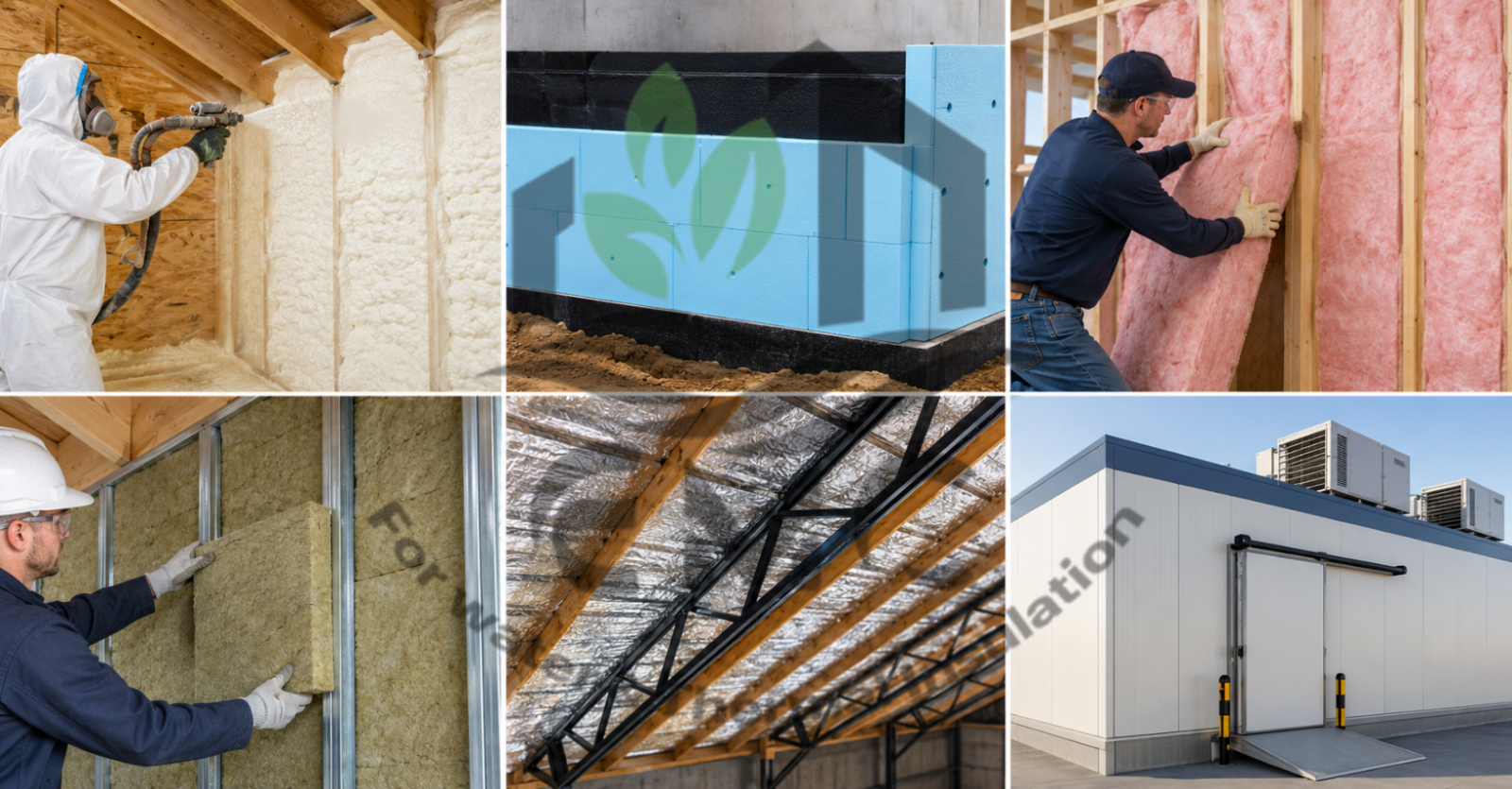
Today, several thermal insulation materials are available, including polyurethane foam, XPS extruded polystyrene, EPS expanded polystyrene, glass wool, rock wool, and various reflective insulation systems.
The performance of each system varies according to thermal conductivity, insulation thickness, density, application method, substrate type, moisture exposure, fire-performance requirements, and surrounding environmental conditions.
In this guide, we examine the best types of thermal insulation, the advantages and limitations of each system, their main applications, and the key factors that should be considered when selecting the most suitable thermal insulation solution for different buildings and structures.
What Is Thermal Insulation?
Thermal insulation is the use of specially designed materials and systems to reduce heat transfer between two environments with different temperatures.
In buildings, thermal insulation acts as a barrier that limits heat transfer between the external environment and indoor spaces, whether heat is moving from outside to inside in hot climates or from inside to outside during colder conditions.
Thermal insulation is mainly intended to:
-
Reduce heat transfer through building elements.
-
Improve indoor temperature stability.
-
Reduce loads on air-conditioning systems.
-
Improve energy efficiency.
-
Provide a more comfortable indoor environment.
-
Reduce heat loss in cooled or heated facilities.
The effectiveness of insulation does not depend solely on the material itself. It depends on the entire insulation system, including:
-
Type of insulation material.
-
Applied thickness.
-
Density.
-
Installation or spray quality.
-
Continuity of the insulation layer.
-
Treatment of joints and details.
-
Reduction of thermal bridges.
-
Position of the insulation layer within the building assembly.
Why Is Thermal Insulation Essential in Buildings and Structures?
Buildings are constantly exchanging heat with the surrounding environment.
In hot climates, roofs and external walls absorb heat from solar radiation and outdoor air temperatures. This heat then gradually transfers into the building.
Without an appropriate insulation system, air-conditioning systems must operate for longer periods to compensate for this additional heat.
The main benefits of thermal insulation include:
Reducing Heat Transfer
Insulation acts as a layer that resists heat flow, reducing the amount of heat transferred through roofs, walls, and floors.
Improving Energy Efficiency
When thermal loads on the building are reduced, heating and cooling equipment does not need to operate at maximum capacity for extended periods.
The actual amount of energy savings depends on several factors, including building design, percentage of insulated surfaces, climate, insulation thickness, HVAC efficiency, and quality of installation.
Improving Thermal Comfort
Insulation helps reduce rapid temperature fluctuations inside the building and provides a more stable and comfortable indoor environment.
Reducing HVAC Loads
The lower the heat transfer, the lower the demand placed on heating and cooling systems, helping improve operating efficiency.
Protecting Industrial Facilities and Warehouses
In factories, warehouses, cold rooms, poultry farms, and agricultural facilities, temperature control is often a critical part of operations.
Proper insulation can help reduce energy losses and improve the stability of internal operating conditions.
Supporting Building Sustainability
Reducing energy consumption helps lower the use of resources associated with operating buildings over the long term.
How Does Heat Transfer Through Buildings?
Heat is transferred through three main mechanisms. Understanding them helps in selecting the most appropriate insulation system.
Conduction
Conduction is the direct transfer of heat through solid materials.
For example, when a concrete roof is exposed to sunlight, its external surface heats up and that heat gradually passes through the concrete into the building.
Thermal insulation materials help reduce this transfer.
Convection
Convection occurs when heat is transferred through the movement of air or liquids.
In buildings, this may occur through air gaps or leakage points within the building envelope.
For this reason, sealing joints and openings is an important part of an effective thermal insulation strategy.
Radiation
Heat can also be transferred through radiation, with solar energy being the most common example.
Reflective insulation systems can be used to reduce radiant heat transfer when they are properly designed and installed with the required air gap where applicable.
Where Is Thermal Insulation Used?
Thermal insulation systems are used in a wide range of applications, including:
-
Concrete roofs.
-
Metal roofs.
-
External walls.
-
Building façades.
-
Floors.
-
Basements.
-
Warehouses and hangars.
-
Factories.
-
Storage facilities.
-
Hospitals.
-
Universities and schools.
-
Shopping centers.
-
Office buildings.
-
Hotels.
-
Cold rooms and freezer rooms.
-
Industrial refrigeration facilities.
-
Food storage facilities.
-
Poultry farms.
-
Greenhouses.
-
Pipelines.
-
Selected industrial equipment and facilities.
The appropriate system is selected according to the nature of each application and its specific performance requirements.
How Is Thermal Insulation Performance Measured?
Several technical indicators are used to evaluate thermal insulation materials and systems.
Thermal Conductivity – λ
Thermal conductivity measures the ability of a material to conduct heat and is typically expressed in:
W/m·K
In general:
The lower the thermal conductivity, the better the material is at resisting heat transfer under comparable conditions.
However, thermal conductivity varies depending on:
-
Material formulation.
-
Density.
-
Temperature.
-
Age.
-
Moisture content.
-
Testing method.
For this reason, the technical data sheet of the actual insulation product should always be reviewed before use.
Thermal Resistance – R-Value
The R-Value expresses the resistance of an insulation layer to heat flow.
The higher the R-Value, the greater the thermal resistance.
R-Value depends on:
-
Type of insulation material.
-
Thickness.
-
Thermal properties of the material.
Therefore, insulation materials should not be compared using R-Value alone without considering thickness.
Thermal Transmittance – U-Value
The U-Value represents the amount of heat transferred through an entire building element, such as a roof or wall.
Unlike R-Value:
The lower the U-Value, the better the thermal performance of the building element.
U-Value depends on all layers within the roof or wall assembly, not only on the insulation layer.
What Are Thermal Bridges?
A thermal bridge is an area where heat can pass through the building envelope faster than through surrounding areas due to a break in the insulation layer or the presence of a material with higher thermal conductivity.
Common thermal bridge locations include:
-
Columns.
-
Beams.
-
Metal connections.
-
Façade fixing points.
-
Joints between insulation boards.
-
Areas where the insulation layer is interrupted.
For this reason, maintaining continuity of the insulation layer is one of the most important factors in achieving effective thermal performance.
Types of Thermal Insulation
Several types of thermal insulation are commonly used in the construction industry, including:
-
Polyurethane foam.
-
XPS extruded polystyrene.
-
EPS expanded polystyrene.
-
Glass wool.
-
Rock wool or mineral wool.
-
Reflective insulation systems.
Each system differs in thermal performance, moisture resistance, compressive strength, fire behavior, and installation method.
First: Polyurethane Foam Thermal Insulation
Polyurethane foam is considered one of the most efficient thermal insulation materials commonly used in the construction industry.
It is characterized by low thermal conductivity and can be spray-applied to form a continuous insulation layer that covers complex surfaces and details.
It is widely used in:
-
Roofs.
-
Warehouses and hangars.
-
Factories.
-
Cold rooms.
-
Industrial facilities.
-
Metal roofs.
How Does Polyurethane Foam Work?
Two components are mixed using specialized spray equipment that operates under controlled pressure and temperature conditions.
Once the material leaves the spray gun, it expands rapidly and adheres to the substrate, forming a continuous foam layer.
Closed-cell polyurethane foam is commonly used in many roof applications because it provides:
-
High thermal resistance.
-
Low water absorption compared with open-cell foam.
-
Good compressive strength.
-
Fewer joints.
-
Good adhesion when the substrate is properly prepared.
Why Is Polyurethane One of the Most Effective Thermal Insulation Systems?
High Thermal Performance with Limited Thickness
Polyurethane foam has low thermal conductivity, allowing it to achieve high thermal resistance with relatively less thickness than many traditional insulation materials.
Continuous Insulation Layer
Because polyurethane is spray-applied, it can form a continuous insulation layer across corners, penetrations, and irregular details.
This helps reduce thermal bridging caused by gaps or joints.
Suitable for Irregular Surfaces
The foam follows the shape of the substrate during application, making it suitable for complex or uneven surfaces.
Fast Installation
Large areas can be insulated relatively quickly using specialized spray equipment.
Suitable for Moisture-Prone Applications When Properly Designed
Closed-cell polyurethane foam has low water absorption and can be incorporated into integrated thermal and moisture-control systems depending on project requirements.
Main Applications of Polyurethane Foam
Polyurethane foam is commonly used in:
-
Concrete roofs.
-
Metal roofs.
-
Warehouses and hangars.
-
Factories.
-
Storage facilities.
-
Cold rooms.
-
Freezer rooms.
-
Refrigeration facilities.
-
Food storage facilities.
-
Poultry farms.
-
Greenhouses.
-
Office buildings.
-
Hospitals.
-
Schools and universities.
-
Selected floor applications.
Polyurethane Foam for Concrete Roof Insulation
Concrete roofs are continuously exposed to direct solar radiation and are therefore one of the main routes for heat transfer into a building.
When polyurethane foam is applied to the roof, it forms a continuous insulation layer that helps reduce heat transfer through the concrete slab.
In exposed applications, a suitable protective coating is normally applied over the foam to protect it from ultraviolet radiation and environmental exposure.
Polyurethane Foam for Metal Roofs and Hangars
Metal roofs have relatively high thermal conductivity and can transfer heat rapidly into the building.
Thermal insulation is therefore particularly important in:
-
Factories.
-
Warehouses.
-
Hangars.
-
Poultry farms.
-
Agricultural facilities.
Polyurethane foam can be sprayed directly onto properly prepared metal surfaces, creating a continuous insulation layer.
Thermal Insulation for Cold Rooms and Refrigeration Facilities
Cold rooms and freezer rooms need to maintain a large temperature difference between indoor and outdoor environments with minimal energy loss.
Polyurethane foam is widely used in:
-
Cold rooms.
-
Freezer rooms.
-
Industrial refrigerators.
-
Food storage facilities.
-
Sandwich panels.
This is mainly due to its ability to provide high thermal resistance with relatively limited thickness.
Does Polyurethane Foam Require a Protective Coating?
In exterior exposed applications, yes.
Continuous ultraviolet exposure can affect the surface of polyurethane foam, so an appropriate protective layer is typically required, such as selected acrylic coatings or other protection systems based on project requirements.
Where higher mechanical or waterproofing resistance is required, an appropriate protective system can be designed according to the intended use.
Advantages of Polyurethane Foam
-
High thermal resistance per unit thickness.
-
Ability to create a continuous insulation layer.
-
Reduced thermal bridging when properly applied.
-
Fast installation.
-
Relatively lightweight.
-
Suitable for irregular surfaces.
-
Widely used in refrigeration applications.
-
Closed-cell foam provides low water absorption.
Limitations of Polyurethane Foam
-
Requires specialized spray equipment.
-
Requires trained applicators.
-
Mixing ratio, pressure, and temperature must be carefully controlled.
-
Requires ultraviolet protection in exposed applications.
-
Initial cost may be higher than some traditional systems.
-
Project-specific fire requirements must be considered.
Second: XPS Extruded Polystyrene
Extruded Polystyrene (XPS) is commonly known in the Egyptian market as blue foam, although XPS boards may be manufactured in different colors depending on the supplier.
It is one of the most commonly used rigid thermal insulation materials in buildings.
XPS has a relatively closed-cell structure that provides good thermal insulation, moisture resistance, and compressive strength for many applications.
How Is XPS Manufactured?
XPS production begins with polystyrene resin pellets.
The manufacturing process generally includes:
-
Melting the polystyrene pellets.
-
Mixing them with required additives.
-
Introducing a blowing agent.
-
Processing the mixture under controlled temperature and pressure.
-
Extruding the material through a die.
-
Forming a continuous foam board.
-
Cooling and cutting the boards to the required dimensions.
This process creates a cellular structure that gives the material its thermal and mechanical properties.
Advantages of XPS
-
Good thermal performance.
-
Good resistance to water absorption.
-
Suitable compressive strength for many applications.
-
Easy to transport and install.
-
Does not require spray equipment.
-
Easy to cut and shape.
-
Suitable for roofs, walls, and floors.
-
Available in different thicknesses and densities.
-
Cost-effective for many projects.
Limitations of XPS
-
Joints between boards require careful installation.
-
Poor installation may create thermal bridges.
-
Requires appropriate protection and finishing depending on the application.
-
Thermal performance per unit thickness is generally lower than some high-performance closed-cell polyurethane systems.
-
Fire-performance requirements must be considered.
Where Is XPS Used?
XPS is commonly used in:
-
Roofs.
-
Walls.
-
Floors.
-
Foundations.
-
Selected basement applications.
-
Inverted roof systems.
-
Cold rooms.
-
Areas requiring good compressive strength.
Polyurethane Foam or XPS?
Both systems can deliver excellent performance when correctly selected and installed.
XPS is easy to install, does not require specialized spray equipment, and can be an economical solution in many applications.
Closed-cell polyurethane foam, on the other hand, generally provides higher thermal resistance per unit thickness and can form a continuous insulation layer with fewer joints.
The choice depends on:
-
Substrate type.
-
Available thickness.
-
Budget.
-
Installation speed.
-
Surface complexity.
-
Moisture exposure.
-
Mechanical loads.
-
Project requirements.
Third: EPS Expanded Polystyrene
Expanded Polystyrene (EPS) is one of the most common lightweight thermal insulation materials.
It is manufactured from polystyrene beads that are expanded and bonded together to form rigid foam boards.
It is commonly known as white foam.
Advantages of EPS
-
Lightweight.
-
Easy to transport and install.
-
Relatively economical.
-
Available in different densities.
-
Provides good thermal performance.
-
Easy to cut and shape.
Limitations of EPS
-
Moisture resistance and compressive strength depend on product density and grade.
-
It generally requires greater thickness than some XPS or polyurethane systems to achieve equivalent thermal resistance.
-
Requires protection depending on its location.
-
Fire-performance requirements must be considered.
Fourth: Glass Wool
Glass wool is an insulation material manufactured from fine glass fibers arranged in a structure that traps air between the fibers.
The trapped air helps reduce heat transfer through the material.
Glass wool is available in several forms, including:
-
Rolls.
-
Boards.
-
Insulation blankets.
-
Preformed pipe sections.
Advantages of Glass Wool
-
Lightweight.
-
Available in several forms.
-
Provides good thermal performance when correctly installed.
-
Suitable for walls, roofs, and hangars.
-
Also contributes to acoustic insulation.
-
Available in various densities and specifications.
Limitations of Glass Wool
-
Requires careful installation to avoid gaps.
-
Incorrect compression may reduce thermal performance.
-
Moisture-control measures may be required depending on the application.
-
Appropriate protective equipment should be used during cutting and installation.
-
May require greater thickness than some foam systems to achieve similar thermal resistance.
Fifth: Rock Wool or Mineral Wool
Rock wool is a widely used thermal and acoustic insulation material produced by melting mineral materials and converting them into fibers.
It is particularly suitable for applications where both thermal insulation and fire resistance are important.
Advantages of Rock Wool
-
Good thermal insulation performance.
-
Good acoustic performance.
-
High fire resistance in suitable systems.
-
Suitable for walls, roofs, and façades.
-
Available in boards and various densities.
-
Widely used in industrial applications.
Limitations of Rock Wool
-
May require greater thickness than some foam systems.
-
Requires proper installation and protection in humid environments.
-
Some products are heavier than glass wool.
-
Cost varies significantly depending on density and application.
Sixth: Reflective Thermal Insulation
Some insulation systems use reflective metallic surfaces, such as aluminum foil, to reduce radiant heat transfer.
However, these systems differ from conventional bulk insulation materials such as foam and mineral wool.
For a radiant barrier to work effectively, it must be correctly designed and usually requires an appropriate air space facing the reflective surface.
Reflective foil alone should therefore not be considered a direct substitute for all conventional thermal insulation systems.
Common applications include:
-
Certain metal roof systems.
-
Air cavities.
-
Composite roof assemblies.
-
Selected industrial applications.
Comparison of Common Thermal Insulation Systems
| System | Thermal Performance per Unit Thickness | Moisture Resistance | Compressive Strength | Fire Performance | Installation | Common Applications |
|---|---|---|---|---|---|---|
| Closed-Cell Polyurethane Foam | Very High | Relatively High | Good to High Depending on System | Requires Appropriate Fire Protection Design | Requires Specialized Equipment | Roofs, hangars, cold rooms |
| XPS | High | High | Good to High | Fire Requirements Must Be Considered | Relatively Easy | Roofs, floors, walls |
| EPS | Good | Moderate to Good Depending on Product | Depends on Density | Fire Requirements Must Be Considered | Easy | Walls, roofs, façades |
| Glass Wool | Good | Requires Appropriate Moisture Design | Relatively Low | Depends on Product and System | Moderate | Roofs, walls, hangars |
| Rock Wool | Good | Good with Appropriate System | Depends on Density | Very High in Suitable Products | Moderate | Façades, walls, industrial facilities |
| Reflective Insulation | Depends on System Design | Depends on System | Low | Depends on Product | Relatively Easy | Roofs and air cavities |
Important Note: The best insulation material cannot be selected based on one property alone. Thermal performance, moisture resistance, fire safety, compressive strength, installation method, service life, and project requirements must all be considered.
Which Thermal Insulation System Is Suitable for Each Application?
| Application | Commonly Suitable Systems |
|---|---|
| Concrete Roofs | Polyurethane Foam, XPS |
| Metal Roofs | Polyurethane Foam, Mineral Wool in Suitable Systems |
| Floors | XPS, High-Density EPS, Polyurethane Depending on Design |
| Cold Rooms and Freezer Rooms | Polyurethane Foam, PIR/PUR Panels, XPS in Selected Applications |
| Poultry Farms | Polyurethane Foam, Glass Wool or Mineral Wool in Suitable Systems |
| External Walls | XPS, EPS, Rock Wool, Polyurethane Depending on System |
| Façades with High Fire-Resistance Requirements | Rock Wool in Appropriate Systems |
| Areas with Limited Insulation Thickness | High-Performance Polyurethane Foam |
| Areas Exposed to Pressure and Moisture | XPS or Suitable High-Density Foam Systems |
Important: This table is for general guidance only and does not replace a detailed technical assessment of the project.
Is Polyurethane Better Than XPS and Glass Wool?
In terms of thermal resistance per unit thickness, closed-cell polyurethane foam generally outperforms XPS and many traditional glass wool systems.
However, this does not mean that polyurethane is automatically the best choice for every project.
For example:
-
XPS may be more suitable where rigid boards with good moisture and compressive resistance are required.
-
Rock wool may be more suitable where fire resistance is a primary requirement.
-
Glass wool may provide an economical and practical solution for certain walls and roof assemblies.
-
Polyurethane foam is particularly attractive where high thermal performance, limited thickness, fast application, and continuity of insulation are priorities.
Therefore, the best insulation system is the one that is most suitable for the project—not simply the one that performs best in a single property.
How to Choose the Best Thermal Insulation System
Thermal insulation should not be selected based only on cost per square meter.
The main factors that should be considered include:
1. Required Thermal Resistance
The required thermal performance should be determined according to the building design and climatic conditions.
2. Available Thickness
In some projects, available space is limited, making materials with higher thermal resistance per unit thickness more suitable.
3. Type of Substrate
The appropriate insulation system depends on whether the surface is:
-
Concrete.
-
Metal.
-
Wall.
-
Floor.
-
Roof.
-
Cold room.
4. Moisture and Water Exposure
The expected exposure to moisture or water must be evaluated because some insulation materials are more sensitive to wet conditions than others.
5. Compressive Strength
Floors and areas subject to loads require insulation materials with suitable compressive strength.
6. Fire Requirements
Insulation materials vary significantly in fire behavior, so the selected system must comply with the fire requirements of the project and building type.
7. Thermal Bridging
Even excellent insulation materials may lose a significant part of their performance if gaps or discontinuities are present.
8. Heating and Cooling Requirements
Freezer rooms and refrigerated warehouses have completely different requirements from residential roofs or office buildings.
9. Service Life
The system should be evaluated according to its ability to maintain thermal performance over the long term.
10. Life Cycle Cost
The decision should not be based only on installation cost.
The following should also be considered:
-
Installation cost.
-
Expected service life.
-
Maintenance requirements.
-
Energy consumption.
-
Repair or replacement costs.
Common Mistakes That Reduce Thermal Insulation Performance
Even the best insulation materials may fail to achieve the expected performance if installed incorrectly.
Selecting Thickness Without Thermal Calculations
Choosing the material alone is not enough. The correct thickness must be determined according to the required thermal resistance.
Leaving Gaps Between Insulation Boards
Gaps may become thermal bridges and reduce the effectiveness of the overall system.
Poor Treatment of Penetrations
Pipes, metal supports, and openings require careful detailing to maintain continuity of insulation.
Incorrectly Compressing Fibrous Insulation
Compressing glass wool or other fibrous materials incorrectly may reduce thermal performance.
Using Materials Unsuitable for Moisture Exposure
Water and moisture exposure should be evaluated before selecting the insulation system.
Neglecting Protective Layers
Some insulation materials require protection from sunlight, fire, or mechanical loads.
Applying Polyurethane Foam Using Unqualified Labor
Spray foam requires careful control of:
-
Mixing ratios.
-
Pressure.
-
Temperature.
-
Thickness.
-
Substrate condition.
Any error in these factors can negatively affect system performance.
Thermal Insulation for Roofs
Roofs are among the most heavily exposed building elements to direct solar radiation, making them one of the most important areas for thermal insulation.
Common roof insulation systems include:
-
Polyurethane foam.
-
XPS boards.
-
EPS in selected systems.
-
Mineral wool in appropriate roof assemblies.
-
Radiant barriers as part of certain systems.
The system should be selected according to roof type, intended use, moisture exposure, mechanical loads, and waterproofing requirements.
Thermal Insulation for Metal Roofs
Metal roofs absorb and transfer heat rapidly due to their relatively high thermal conductivity.
Thermal insulation is therefore especially important in:
-
Factories.
-
Warehouses.
-
Hangars.
-
Poultry farms.
-
Agricultural facilities.
Spray polyurethane foam is one suitable solution because it can form a continuous insulation layer over properly prepared metal surfaces.
Thermal Insulation for Poultry Farms and Greenhouses
Maintaining stable temperatures inside poultry farms and greenhouses is essential for efficient operation.
Uncontrolled heat transfer increases the load on heating, cooling, and ventilation systems.
A properly designed insulation system can help:
-
Improve temperature stability.
-
Reduce heat transfer.
-
Reduce thermal loads.
-
Improve operating conditions.
However, there is no fixed energy-saving percentage that applies to every project. Actual savings depend on facility design, insulation type and thickness, climate, ventilation, and cooling systems.
Thermal Insulation for Cold Rooms and Freezer Rooms
Cold rooms and freezer rooms require high-performance insulation to reduce heat transfer from the surrounding environment.
The greater the heat gain, the more energy the refrigeration system must consume to maintain the required temperature.
For this reason, polyurethane systems are widely used in:
-
Cold rooms.
-
Freezer rooms.
-
Refrigeration facilities.
-
Food storage facilities.
-
Sandwich panels.
Does Thermal Insulation Reduce Electricity Consumption?
Thermal insulation does not reduce electricity bills by a fixed percentage. Instead, it reduces heat transfer through the building envelope.
This can reduce the load on air-conditioning, cooling, and heating systems, which may result in lower energy consumption.
Actual savings depend on:
-
Building area.
-
Area of insulated roofs and walls.
-
Type of insulation.
-
Thickness.
-
Climate.
-
Required indoor temperature.
-
HVAC efficiency.
-
Building airtightness.
-
Window and glazing type.
-
Building operation.
For this reason, any accurate energy-saving percentage should be based on a project-specific energy analysis or thermal calculation.
Why Choose EMC for Thermal Insulation Works?
The success of a thermal insulation system does not depend only on choosing a material with low thermal conductivity. It also depends on technical assessment, selecting the correct system and thickness, preparing the substrate, and ensuring high-quality installation.
At EMC, each project is evaluated independently according to the nature of the structure and its operational requirements.
EMC thermal insulation services include:
-
Concrete roof insulation.
-
Metal roof insulation.
-
Spray polyurethane foam systems.
-
Factory and warehouse insulation.
-
Storage facility insulation.
-
Poultry farm insulation.
-
Agricultural facility insulation.
-
Cold room and freezer room insulation.
-
Protective coating systems over polyurethane foam.
-
Selection of the appropriate insulation system and thickness according to project requirements.
Polyurethane foam systems installed by EMC can provide high thermal performance, fast application, and continuous coverage across different surfaces and details when applied according to the required specifications.
Frequently Asked Questions About Thermal Insulation
What Is the Best Type of Thermal Insulation?
There is no single thermal insulation system that is best for every project.
Closed-cell polyurethane foam provides high thermal resistance per unit thickness, while other systems may offer advantages in fire resistance, ease of installation, or cost.
Which Is Better: XPS or Polyurethane Foam?
It depends on the project.
XPS offers easy installation and good resistance to moisture and compression, while closed-cell polyurethane foam usually provides higher thermal resistance per unit thickness and can form a continuous insulation layer.
What Is the Difference Between White Foam and Blue Foam?
White foam usually refers to EPS, while blue foam in the Egyptian market generally refers to XPS.
They differ in manufacturing process, cellular structure, density, compressive strength, moisture resistance, and thermal performance.
What Is Thermal Conductivity?
Thermal conductivity measures the ability of a material to conduct heat.
In general, the lower the thermal conductivity, the better the insulation performance under comparable conditions.
What Is R-Value?
R-Value represents the thermal resistance of an insulation layer.
The higher the R-Value, the greater the resistance to heat transfer.
Does Increasing Insulation Thickness Improve Performance?
Yes. In most insulation systems, increasing thickness increases thermal resistance.
However, the required thickness should be determined based on project requirements and thermal calculations.
Does Polyurethane Also Provide Waterproofing?
Closed-cell polyurethane foam has low water absorption and can contribute to moisture control as part of an integrated system.
However, exposed roof applications require a properly designed protective system, and not all polyurethane foam products offer the same level of water resistance.
Is Rock Wool Better Than Polyurethane?
It depends on project priorities.
Polyurethane provides high thermal resistance per unit thickness in many applications, while rock wool offers strong fire-resistance performance in suitable systems.
Does Thermal Insulation Save Electricity?
Thermal insulation can reduce the thermal loads placed on cooling and heating systems and may therefore contribute to lower energy consumption.
The actual amount of savings varies from one project to another.
What Is the Best Thermal Insulation for Roofs?
The correct solution depends on the type of roof and project requirements.
Common systems include:
-
Polyurethane foam.
-
XPS.
-
Selected EPS systems.
-
Mineral wool in suitable assemblies.
Polyurethane foam is particularly useful where continuous insulation and high thermal performance with limited thickness are required.
Can Existing Buildings Be Thermally Insulated?
Yes.
Thermal insulation systems can be added to many existing buildings after evaluating the condition of the surface and designing the appropriate system for roofs, walls, or other parts of the building envelope.
Conclusion
Thermal insulation is one of the most important elements in improving the performance of modern buildings. It helps reduce heat transfer, improve thermal comfort, decrease loads on heating and cooling systems, and contribute to lower energy consumption over the long term.
With a wide range of thermal insulation systems available, including polyurethane foam, XPS, EPS, glass wool, rock wool, and reflective insulation systems, choosing the correct solution should be treated as an engineering decision rather than one based solely on material price.
The best insulation system is the one that provides the required thermal resistance while also matching the substrate, available thickness, environmental conditions, fire requirements, moisture exposure, and expected service life of the project.
Closed-cell polyurethane foam stands out as one of the most efficient solutions for many applications where high thermal performance with limited thickness is required, particularly in roofs, warehouses, factories, and cold rooms. However, systems such as XPS, rock wool, and glass wool remain important solutions with their own advantages and suitable applications.
Ultimately, achieving effective thermal insulation starts with proper project assessment, followed by selecting the appropriate material, system, and thickness, and finally ensuring professional installation in accordance with the required technical specifications.
Do You Need Technical Consultation for Your Project?
If you are looking for the best thermal insulation system for your project, the EMC team can assess the structure, substrate type, operating conditions, and required thermal performance to determine the most technically and economically suitable insulation system and thickness, and execute the insulation works in accordance with project requirements and engineering specifications.