Roof Insulation with Polyurethane Foam
What is Polyurethane Foam?
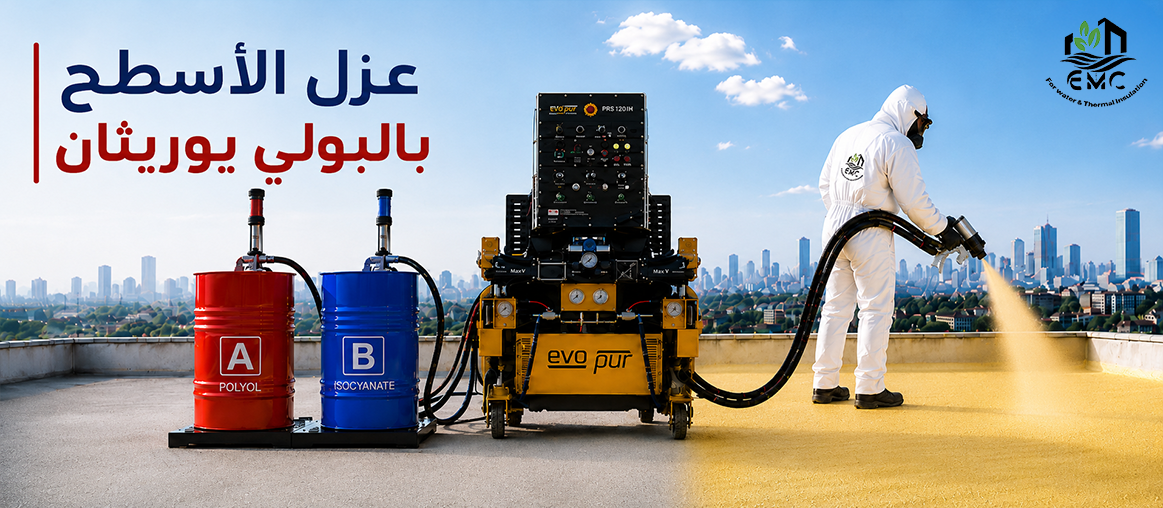
Polyurethane Foam is one of the most widely used industrial materials in thermal and waterproofing insulation systems for roofs and buildings. It is produced through a chemical reaction between two main components: Polyol and Isocyanate. These two materials are mixed at a 1:1 ratio inside a high-pressure spray machine, producing foam that expands quickly and hardens within seconds, forming a seamless insulation layer with more than 90% closed-cell structure.
This system is characterized by its ability to create a continuous insulation layer without joints or seams, giving it high efficiency in resisting water leakage and reducing heat transfer. It also provides waterproofing efficiency of up to 100% when applied correctly, high thermal insulation efficiency of up to 100% according to the layer thickness, technical specifications, and application conditions, in addition to reducing sound transmission by up to 30%.
Why is Polyurethane Foam One of the Best Insulation Systems?
The excellence of polyurethane foam comes from its closed-cell structure, which gives it a high ability to resist water penetration and reduce heat transfer. It also has a low thermal conductivity ranging from 0.021 to 0.028 W/m·K, making it one of the most efficient insulation materials for improving energy efficiency inside buildings. When applied as part of a complete insulation system, it can contribute to reducing air-conditioning energy consumption by up to 40%.
It is also lightweight, as a 2.5–3 cm thick layer weighs approximately 1.5–1.6 kg/m² only. In addition, it offers strong adhesion to different types of surfaces, has a fast initial curing time ranging from 9 to 14 seconds, and allows fast application of up to 500 m² per day using one spray machine. This helps reduce execution time while forming a seamless, uniform insulation layer without joints or seams.
How Does Polyurethane Provide Thermal and Waterproofing Insulation?
Polyurethane foam forms a continuous insulation layer that covers all parts of the roof, including corners, joints, detailed areas, and connection points. This reduces the chances of water leakage and prevents weak points within the insulation system.
Its closed-cell structure helps reduce moisture absorption and resist water penetration, while its low thermal conductivity limits heat transfer. This helps maintain a more stable indoor temperature and reduces pressure on air-conditioning systems.
System Advantages
- Provides waterproofing efficiency of up to 100% when applied correctly.
- Provides thermal insulation efficiency of up to 100% according to the layer thickness and technical specifications.
- Helps reduce sound transmission by up to 30%.
- Combines thermal insulation and waterproofing in one system.
- Contributes to reducing energy consumption by up to 40%.
- Features low thermal conductivity of 0.021–0.028 W/m·K.
- Contains more than 90% closed cells to resist moisture and water penetration.
- Forms a continuous insulation layer without joints or seams.
- Application speed of up to 500 m² per day.
- Initial curing time ranges from 9 to 14 seconds.
- Lightweight with high adhesion strength to different types of surfaces.
- Resistant to insects, fungi, and bacteria.
- Fire resistance of up to 4 hours.
- Long service life when a protective coating is applied.
Areas of Application
The polyurethane foam system is used for insulating concrete roofs, metal roofs, hangars, factories, residential buildings, and commercial buildings, in addition to many other facilities that require a highly efficient thermal and waterproofing insulation system.
Application Steps
1. Surface Preparation
The surface is thoroughly cleaned to remove dust, impurities, oils, and loose materials. Cracks and any surface defects are also treated to ensure maximum adhesion strength and insulation efficiency.
2. Surface Treatment
The required treatment works are carried out according to the surface condition. This includes rust removal, strengthening weak areas, sealing openings and joints, and treating leakage points using suitable materials to ensure the surface is fully ready before insulation work begins.
3. Polyurethane Foam Spraying
The foam is sprayed using the EvoPur H-19S NEW high-pressure machine, which mixes Polyol and Isocyanate at a 1:1 ratio. The materials are then sprayed at a thickness of 3 cm ± 5 mm to form a uniform and highly efficient insulation layer.
4. Protective Coating
After the foam spraying process is complete, the TRI-ACRYPROOF protective coating is applied. It is a flexible acrylic coating resistant to ultraviolet rays and weather conditions. This layer protects the foam from direct sunlight exposure, maintains the efficiency of the insulation system, and extends its service life.
Acrylic Protective Coating
Applying TRI-ACRYPROOF Acrylic Coating is an essential step to ensure the durability of the insulation system. It provides effective protection against ultraviolet rays, rain, and various weather conditions. It also preserves the foam properties and extends its operational life, ensuring the continued performance of the thermal and waterproofing insulation system with high efficiency for many years.
Technical Specifications
| Item | Specification |
|---|---|
| System Type | Closed-Cell Polyurethane Foam |
| Application Method | High Pressure Spray |
| Spray Machine | EvoPur H-19S NEW |
| Protective Coating | TRI-ACRYPROOF Acrylic Coating |
| Mixing Ratio | 1 : 1 Polyol : Isocyanate |
| Density | 40–45 kg/m³ or 55–60 kg/m³ |
| Thermal Conductivity | 0.021–0.028 W/m·K |
| Foam Layer Thickness | 3 cm ± 5 mm |
| Cell Structure | More than 90% Closed-Cell |
| Waterproofing Efficiency | Up to 100% when applied correctly |
| Thermal Insulation Efficiency | Up to 100% according to technical specifications |
| Sound Transmission Reduction | Up to 30% |
| Initial Curing Time | 9–14 seconds |
| Application Speed | Up to 500 m²/day |
| Layer Weight | 1.5–1.6 kg/m² at 2.5–3 cm thickness |
| Fire Resistance | Up to 4 hours |
| Temperature Range | -25°C to +70°C |
| Use | Thermal Insulation and Waterproofing |
| Suitable Surfaces | All types of surfaces |
Frequently Asked Questions
Is the Polyurethane System Suitable for All Types of Surfaces?
Yes, polyurethane foam can be applied to concrete, metal, wooden, and other surfaces after proper preparation. This ensures high adhesion strength and excellent insulation efficiency.
How Long Does Polyurethane Insulation Take to Apply?
The system is known for its fast application, as areas of up to 500 m² can be completed per day using one spray machine. The initial curing time ranges from 9 to 14 seconds depending on application conditions.
What is the Service Life of the Polyurethane System?
When the system is applied using high-quality materials and the acrylic protective coating is applied according to technical specifications, its service life can reach 15–20 years. This depends on operating conditions, exposure to weather factors, and regular maintenance of the protective coating.
Why Choose the Polyurethane System?
Because it combines waterproofing and thermal insulation with high efficiency of up to 100% when applied correctly, in addition to reducing sound transmission by up to 30%. It is also lightweight, fast to apply, has strong adhesion, and forms a continuous insulation layer without joints, making it one of the best integrated insulation solutions for roofs.
Why Choose EMC?
EMC relies on extensive experience in implementing thermal and waterproofing insulation systems using high-quality materials, modern spray machines, and a specialized technical team committed to the highest quality standards. This ensures effective insulation solutions that meet the requirements of different projects and achieve the highest levels of performance and sustainability.